
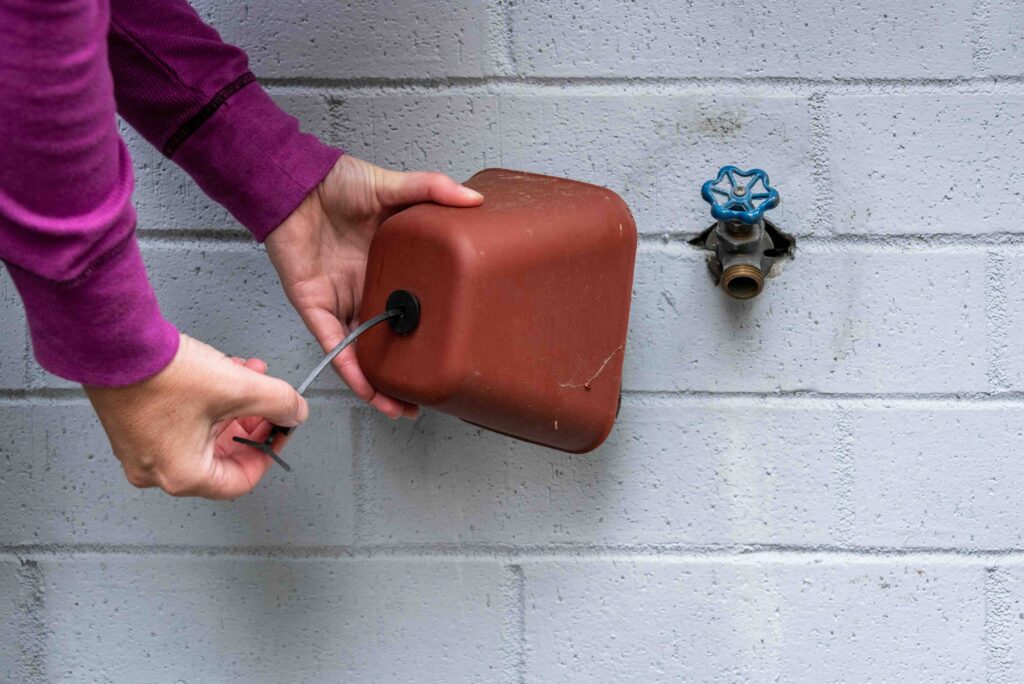


Prepare the faucet before covering it
Water left in an outdoor spigot or its connected pipe can freeze, expand and damage the plumbing. We recommend preparing the faucet before temperatures drop below 32°F (0°C), rather than relying on a cover alone.
- Disconnect the garden hose, splitter, timer or other attachment. An attached hose can hold water at the faucet and prevent it from draining.
- Look for an indoor shutoff valve that supplies the outdoor faucet. If you have one, shut it off and drain the line before covering the spigot.
- Check for exposed pipe near the faucet. A cover over the spigot will not insulate a separate length of pipe.
- Choose a cover or wrap that fits securely around the faucet without leaving large gaps against the wall.
Identify the faucet before choosing protection
A frost-free faucet typically has a longer valve stem that shuts water off farther inside the home. Its handle and outer shape alone may not reliably identify it. If you can see the faucet's model information or the pipe connection from inside, use that information to identify the type. Even a frost-free faucet needs its hose removed so water can drain from the outer section.
With a standard faucet, an indoor shutoff and drained line offer protection that a cover cannot provide on its own. If your plumbing layout is unclear, avoid forcing a valve or opening a fitting you cannot identify.
Shut off and drain a line when you have an indoor valve
If a dedicated indoor valve controls the outdoor faucet, close that valve, then open the outdoor faucet to let water leave the isolated line. Some shutoff valves also have a small drain port; if yours does, follow its instructions and catch the discharged water. Once the line is drained, the outdoor faucet may be left open while its indoor supply remains shut off. Do not leave a pressurized outdoor faucet open or running through winter.
What you can use to cover a spigot
We recommend choosing a material for the area you need to protect, not just for what is close at hand:
- Foam faucet cover: A purpose-made cover fits over the faucet and provides an insulating barrier. Choose one that sits against the wall without a hose or splitter in the way.
- Old towel, blanket or rags: Wrap the fabric around the spigot and secure it with duct tape or bungee cords. Keep it snug, and check it after rain or snow because wet fabric loses insulating value.
- Insulating pipe wrap: Foam or fiberglass wrap can be cut to the length of an exposed pipe. Cover the pipe itself rather than expecting a faucet cover to reach it.
- Bubble wrap: Wrap it around the spigot and secure it with tape or zip ties. It can add a layer, but it does not drain water from the line.
- Plastic bag: A bag held with rubber bands is a quick outer covering, but its thin material offers limited insulation by itself.
Fit a foam faucet cover
- Remove the hose and other attachments so the cover can reach the wall.
- Place the foam cover over the entire faucet, following the cover's fastening method.
- Pull it snug against the wall and check that wind cannot easily dislodge it.
- After a windy spell, check that the cover is still seated and the area beneath it is dry.
A cover slows heat loss; it does not heat the faucet or make water trapped in a connected hose safe from freezing.
Protect exposed pipe beyond the faucet
If pipe is visible in an unheated space or along an exterior wall, measure the exposed length before cutting foam or fiberglass pipe wrap. Fit the wrap around the pipe and secure it according to the material's instructions, leaving valves accessible. A cover fitted over the spigot protects only the area it encloses. Exposed connections and gaps that admit cold air can still affect the line.
Choose protection for the faucet and the forecast
The most useful choice depends on whether the line can be shut off and drained, whether a hose is attached, and how much pipe is exposed. A fitted foam cover is a more suitable faucet covering than a loose plastic bag. If you are using towels or rags, treat them as a temporary option and replace them if they become wet.
Check the forecast for overnight lows, the length of the cold spell and wind exposure. A faucet on a wind-exposed wall or a pipe in an unheated area may cool differently from one sheltered by the home. There is no single outdoor temperature at which every spigot freezes, so prepare ahead of a forecast below 32°F (0°C), especially for a prolonged freeze.