
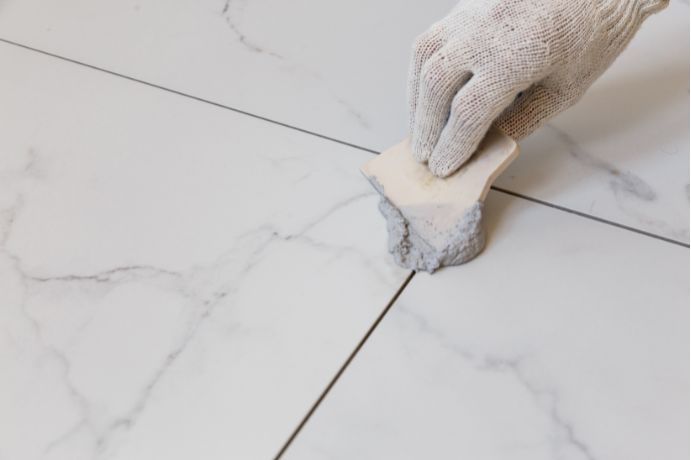


How we decide whether sealing makes sense
We recommend sealing grout when the grout and tile are suitable for it. The first distinction is the grout material: porous cement-based grout can benefit from a compatible sealer, while epoxy grout generally does not need one. Some grout products have built-in stain resistance or their own sealing instructions. A product label or installation record is more useful than assuming every grout joint is the same.
Advice in online discussions, including Reddit, can sound contradictory because it often describes different grout types or locations. Whether your tile is on a kitchen floor or in a shower, check the grout manufacturer's guidance before choosing a sealer. Sealing is an option for easier maintenance, not a rule that applies to every installation.
What grout sealer does
A suitable grout sealer can make porous grout easier to clean and lower the chance that a spill becomes a permanent stain. It does not stop dirt from reaching grout, replace regular cleaning, or guarantee stain prevention. Dirty grout can also result from the tools and methods used to clean a floor, so sealing alone will not correct a cleaning problem.
Water beading is not a reliable measure of long-term protection. It depends in part on whether the sealer is hydrophobic, and an initial beading effect can diminish. In a shower, sealer is not a substitute for the waterproofing system behind the tile or for repairing a leak.
Cleaning and preparation before sealing
For a new installation, follow the grout manufacturer's curing instructions and the sealer's drying requirements before applying anything. For an older or previously lived-in home, we recommend professional tile and grout cleaning before sealing. Sealer applied over soil, cleaning-product residue, or a still-damp joint may produce a disappointing result.
If you are doing the work yourself, match the sealer to both the grout and the adjacent tile. Follow its instructions for application, ventilation, drying, and removal of excess product. Sealing grout lines takes careful, hands-and-knees work, particularly across a large floor. Some sealers can leave a haze on tile when excess product remains on the surface.
Benefits and trade-offs of sealing grout
- Potential benefit: Porous grout may be easier to clean, with less risk of lasting stains from spills.
- Ongoing work: Sealed grout still needs cleaning, and sealer performance may change with use and cleaning.
- Application risk: An incompatible product or residue left on tile can affect the appearance of the finished surface.
- Limit: Sealer does not repair cracked grout, fix a shower leak, or make every grout type more suitable for sealing.
The choice is most useful when you weigh those benefits against the condition of your grout, the tile beside it, and the preparation required. A floor with extensive buildup, for example, calls for cleaning before any sealing decision.
What affects the work and your estimate
The amount of grout to treat matters: a larger tiled area or many narrow tiles can mean more grout lines than a smaller area with large-format tile. Existing soil can add cleaning work before sealing, while tile material and grout type affect product compatibility. Those details are more useful for planning than a price based only on the room's dimensions.
We provide professional tile and grout cleaning and sealing services in Katy and the Houston area. For a free estimate and availability, call or text us at (832) 303-3546. You can also learn about UpFront Home Services.