
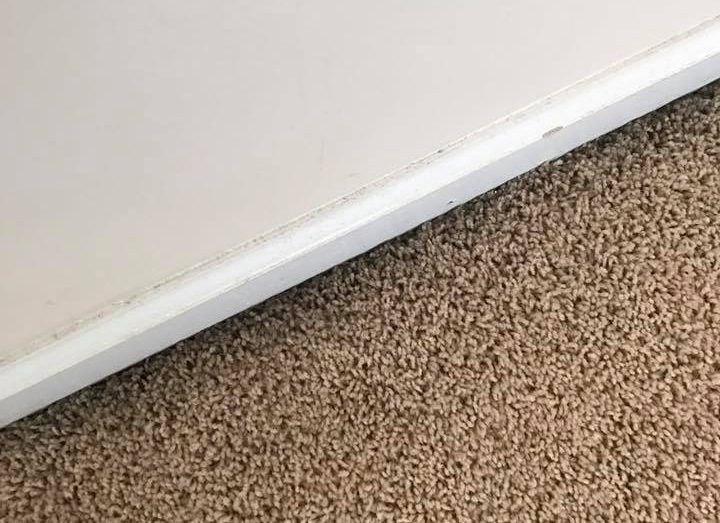


Why dark lines gather at carpet edges
Air can move through small gaps where carpet meets a wall or across a doorway. As it passes through the carpet pile, fine airborne particles collect in a narrow band. Over time, that buildup can look like a black or gray line. Dusty air from vents can contribute, but particles from cooking, candles, and outdoor air can also circulate through a home.
A line that follows a wall or doorway is a useful clue. Color alone is not a diagnosis: a brown mark that appears after cleaning or a spill may have a different cause.
How we treat filtration soiling
For filtration lines, our carpet-cleaning process uses Pro’s Choices PC-45. We spray the treatment, agitate the affected area, and steam clean the carpet. The edge needs attention because a pass over the open floor may not reach soil concentrated against the wall. Fine particles can cling to carpet fibers, so vacuuming alone may leave a visible line.
What affects cleaning results and cost
How much of a line lifts depends on the carpet fiber, how much soil has accumulated, and how long it has been there. A dark, long-standing line may remain visible after cleaning. Longer runs along walls or multiple doorways also mean more affected carpet to treat. A brown mark may call for a different approach rather than repeated treatment as filtration soiling.
For a free estimate and availability for carpet cleaning in the Houston area, call or text us at (832) 303-3546. You can also find us at UpFront Home Services.
How to limit new edge soiling
Reduce the particles and airflow that feed the lines. Vacuum along walls and doorways regularly, address noticeable air gaps where practical, and use ventilation when cooking. We also recommend regular air-duct cleaning where dusty air from vents is contributing. Duct cleaning addresses one possible source of dust; it does not stop particles entering from elsewhere or air moving through carpet edges.
Brown lines need a different approach
Filtration soiling usually follows an airflow path and looks gray or black. Cellulosic browning can appear when moisture draws brown-colored material from a carpet backing or another cellulosic component toward the surface as it dries. If a brown line appeared after a spill or wet cleaning, adding more water or scrubbing it may make the problem harder to address. The location, timing, and carpet construction matter when choosing a treatment.